
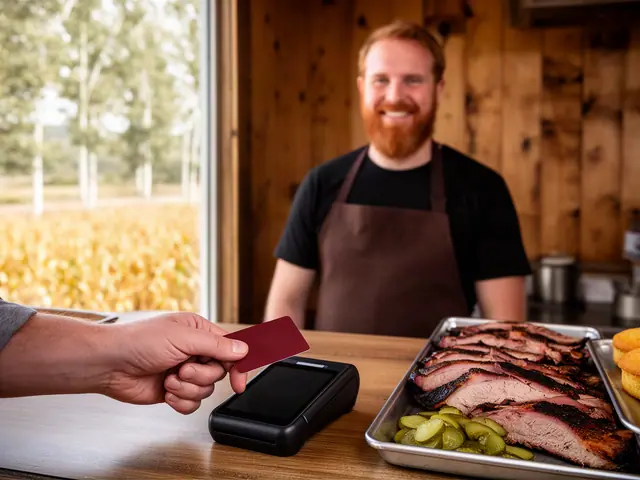

Ridgepoint Credit, a small-business funding service in Owensboro, Kentucky, arranges merchant cash advances for Daviess County, KY businesses with steady card or bank receipts. An advance is a purchase of future receivables, not a loan: the provider collects a share of receipts until an agreed total is remitted. Providers review card volume and consistency and set their own terms.
| What it is | A sale of tomorrow's card receipts, never a loan |
|---|---|
| Collection method | A daily share of sales, or a set debit |
| Counter-service restaurants with staff in Daviess County, KY | 77 locations with paid staff, per CBP 2023 |
How a merchant cash advance works, start to final remittance
A provider buys a fixed amount of the business's future receipts at a discount. The business receives the purchase price now and the provider collects the agreed total over time, usually as a percentage of daily card sales (the holdback) or as fixed daily or weekly debits from the bank account. Collection continues until the agreed total has been remitted.
Because the provider is buying receivables rather than lending, there is no interest rate in the usual sense. The cost is the difference between the cash received and the total remitted.
Is a merchant cash advance a loan under its own paperwork?
No. A merchant cash advance is structured as a sale of future receipts, not a loan, and the paperwork reflects that. That difference affects how the cost is described and which rules apply, so read an advance agreement as its own kind of contract rather than as a loan document.
What is a holdback percentage, and who sets it?
The holdback is the share of each day's card or bank receipts the provider collects. With a holdback, slow days remit less and busy days remit more, so collections follow sales. With fixed debits, the same amount leaves the account each day or week regardless of sales, though some agreements allow reconciliation if sales fall. Ask which method an offer uses.
The guides and calculator page covers the tools on this site; for advance arithmetic, the labeled example below is worked by hand.
A merchant cash advance example, labeled and hypothetical
Suppose a cafe receives an illustrative $10,000 advance and agrees to remit a total of $12,500. The agreed total is a factor of 1.25 on the cash received (every 0.1 of factor adds $10 for every $100 advanced), so it is $2,500 more than the cash. If the holdback is 10% and card sales average $1,250 a day, about $125 is remitted each business day, and the total is reached after roughly 100 business days. Busier days shorten that; slower days lengthen it.
These numbers are for arithmetic only. They are not an offer, a typical cost or a quote from any provider.
Merchant cash advance vs business loan for a card-heavy shop
| Merchant cash advance | Business loan | |
|---|---|---|
| Structure | Future receivables bought at a discount | A sum borrowed and repaid with interest |
| Cost quoted as | Dollars to be remitted in total | Rate, fees and total repayment |
| Collections | Share of receipts or fixed debits | Scheduled installments |
| Early payoff | Total often stays the same; ask | May reduce interest; check prepayment terms |
| Commonly reviewed | Card or deposit volume and consistency | Financials, credit, time in business |
Compare an advance's total payback with a working capital offer over the same period before choosing.
Merchant cash advance vs line of credit for repeat shortfalls
A line of credit charges interest only on the drawn balance and refills as you repay, so for recurring gaps it is worth pricing first if a partner offers one. An advance has a fixed total that does not shrink because you remit faster. Advances can suit a business that needs cash quickly, has strong card sales and cannot yet get a line. Keep both in view and compare totals over the same period.
Card-swipe businesses of Daviess County, KY that weigh advances
Card-heavy businesses: restaurants, with 77 limited-service and 70 full-service employer establishments in the county in 2023 (CBP), and retail shops, with 396 retail employer locations (CBP 2023). Those are the businesses whose daily receipts make a holdback workable.
Card-heavy businesses in the county
Retail (396) and accommodation and food services (197) together account for 593 of Daviess County, KY's 2,385 employer establishments in 2023 (CBP; our sum). The Owensboro, KY page breaks the county down by sector.
Questions to ask any advance provider in writing
- What is the full dollar figure to be remitted?
- Is collection a holdback percentage or a fixed debit?
- Can collections be reconciled if sales fall?
- Does paying early reduce the total?
- Are there fees deducted from the cash you receive?
By Ridgepoint Credit · Updated